



RIP David Sklansky: Poker Strategy Pioneer and Author Dead at 78

pessi-lamm
27 Mar 2026
Pessi Lamm 27 Mar 2026
Share this article
Or copy link
  • David Sklansky, age 78, revolutionized poker with a mathematical approach.
  • Authored 'The Theory of Poker,' a foundational text for strategic play.
  • Won three WSOP bracelets; storied career shaped modern poker thought.
David Sklansky RIP
RIP (credit: Jonas Žnidaršič)
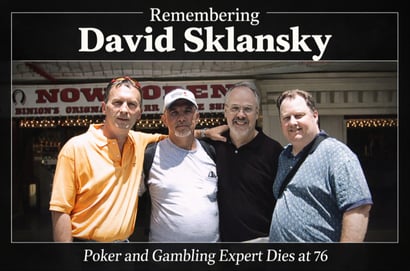
Long before GTO became a dinner table talk at poker rooms across Las Vegas, one man sat down and wrote the mathematical blueprint for how the game should be played. David Sklansky, who passed away on March 23, 2026, aged 78, leaves behind a legacy of information that continues to shape modern poker and new players learning the fundamentals from "The Mathematician" himself.

The Book That Made The Modern Game: The Theory of Poker (1983)

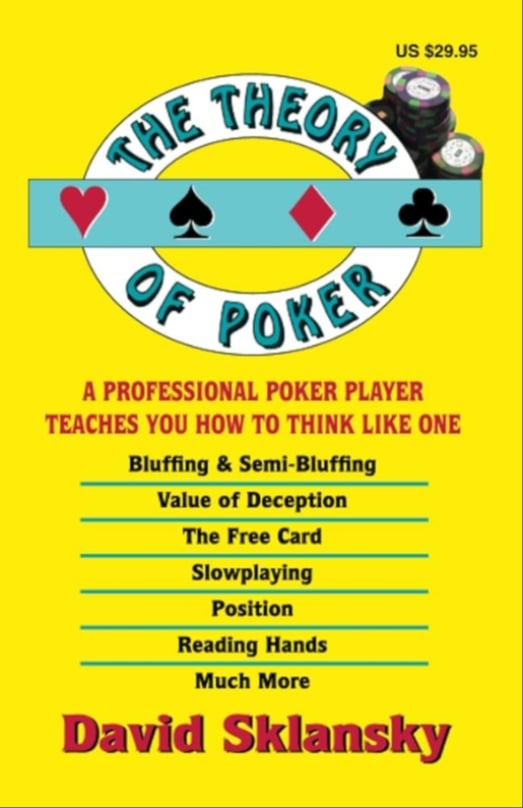
Published in 1983, The Theory of Poker introduced concepts such as pot odds and deception value that now feel like common knowledge but were genuinely radical at a time when most players operated on feel and table image alone. Sklansky's earlier work, Hold'em Poker (1976), holds the distinction of being the first book ever written specifically about Texas Hold'em.

undefined
Book cover of The Theory of Poker by David Sklansky, Two Plus Two Publishing, 1983.

Three WSOP Bracelets and a WPT Final Table: The Tournament Record

Sklansky put his poker theories into practice throughout his career, resulting in multiple WSOP bracelet wins and other notable achievements:
YearAchievement
1979Won $1,000 Razz at Amarillo Slim's Superbowl of Poker
1982Two WSOP bracelets: $1,000 Draw High and $800 Mixed Doubles
1983Third WSOP bracelet: $1,000 Limit Omaha
2004WPT Poker By The Book invitational win, defeating Doyle Brunson heads-up
2006Third place at WPT Championship for $419,040

Why Sklansky's Books Still Matter in the Solver Era

Modern poker training sites run solver outputs, range charts, and node-locking drills. None of that changes the underlying logic Sklansky articulated decades ago. 

His Fundamental Theorem of Poker remains the clearest single-sentence explanation of why poker is a skill game: mistakes have a cost, and that cost is mathematically definable. Solvers calculate those costs to many decimal places. Sklansky explained why they exist at all.

He leaves behind 14 books, three WSOP bracelets, and a framework that will outlast every training tool currently on the market.
  • Hold'em Poker (1976): The first book ever published on Texas Hold'em, covering position play, starting hand selection, flop reading, and blind strategy
  • The Theory of Poker (1983): Sklansky's defining work; introduces the Fundamental Theorem of Poker alongside semi-bluffing, implied odds, deception, and game theory principles that underpin strategy to this day
  • Hold'em Poker for Advanced Players (1987): The most thorough treatment of limit Hold'em ever written; still the reference text for the format
  • Getting the Best of It (1997): Expected value thinking applied across poker, blackjack, sports betting, and casino games
  • Tournament Poker for Advanced Players (2002): Covers ICM pressure, push/fold ranges, and stack-to-blind adjustments before solver tools existed
  • No Limit Hold'em: Theory and Practice (2006): Co-written with Ed Miller; translates Sklansky's mathematical framework into the no-limit game
  • DUCY? (2010): Essays on exploitative play, unconventional strategy, and broader gambling theory

The biggest stage in poker is always the one where the best thinking wins. David Sklansky made sure we all knew how to think. Rest in peace.

Latest News

Upcoming Events